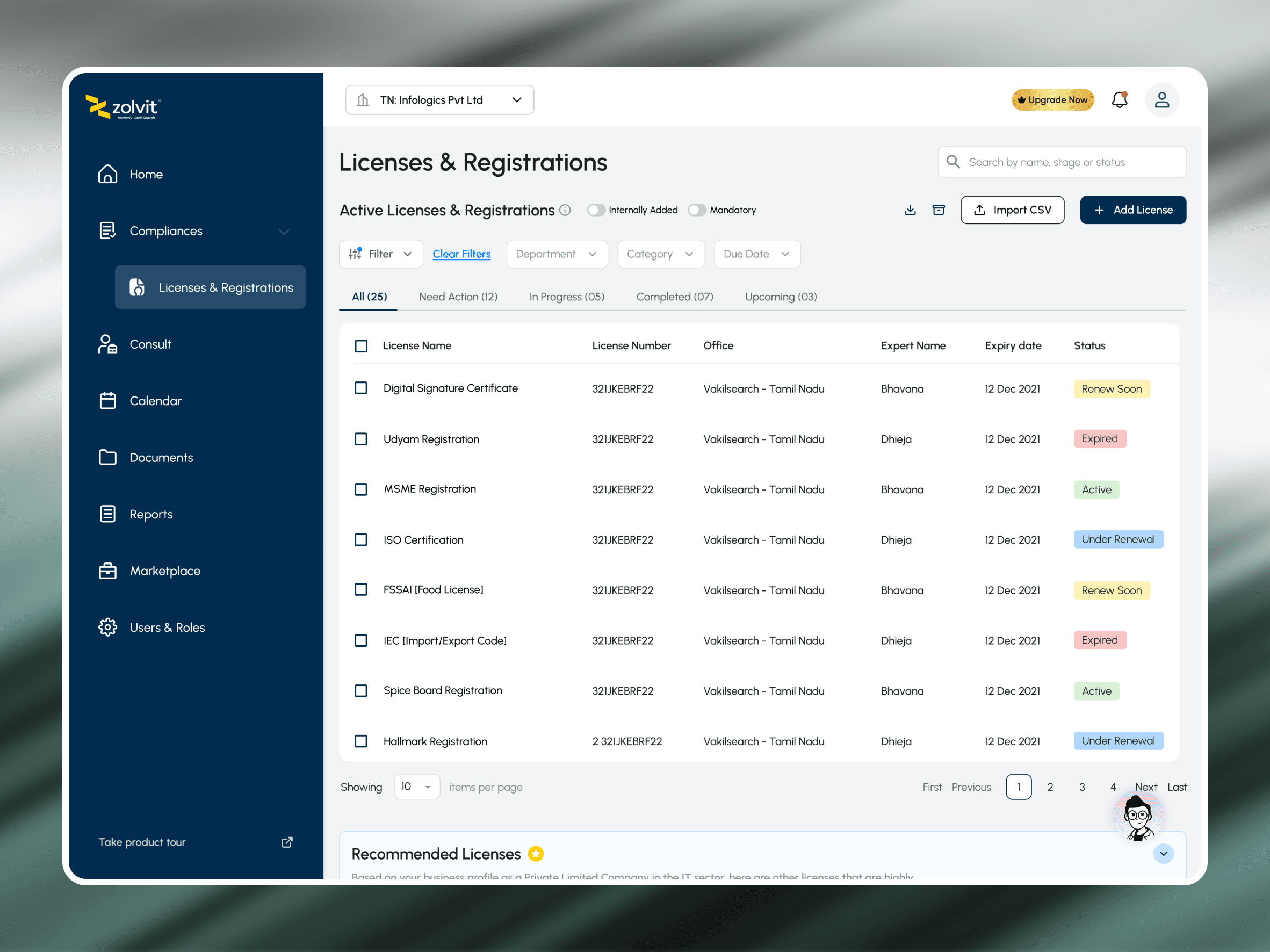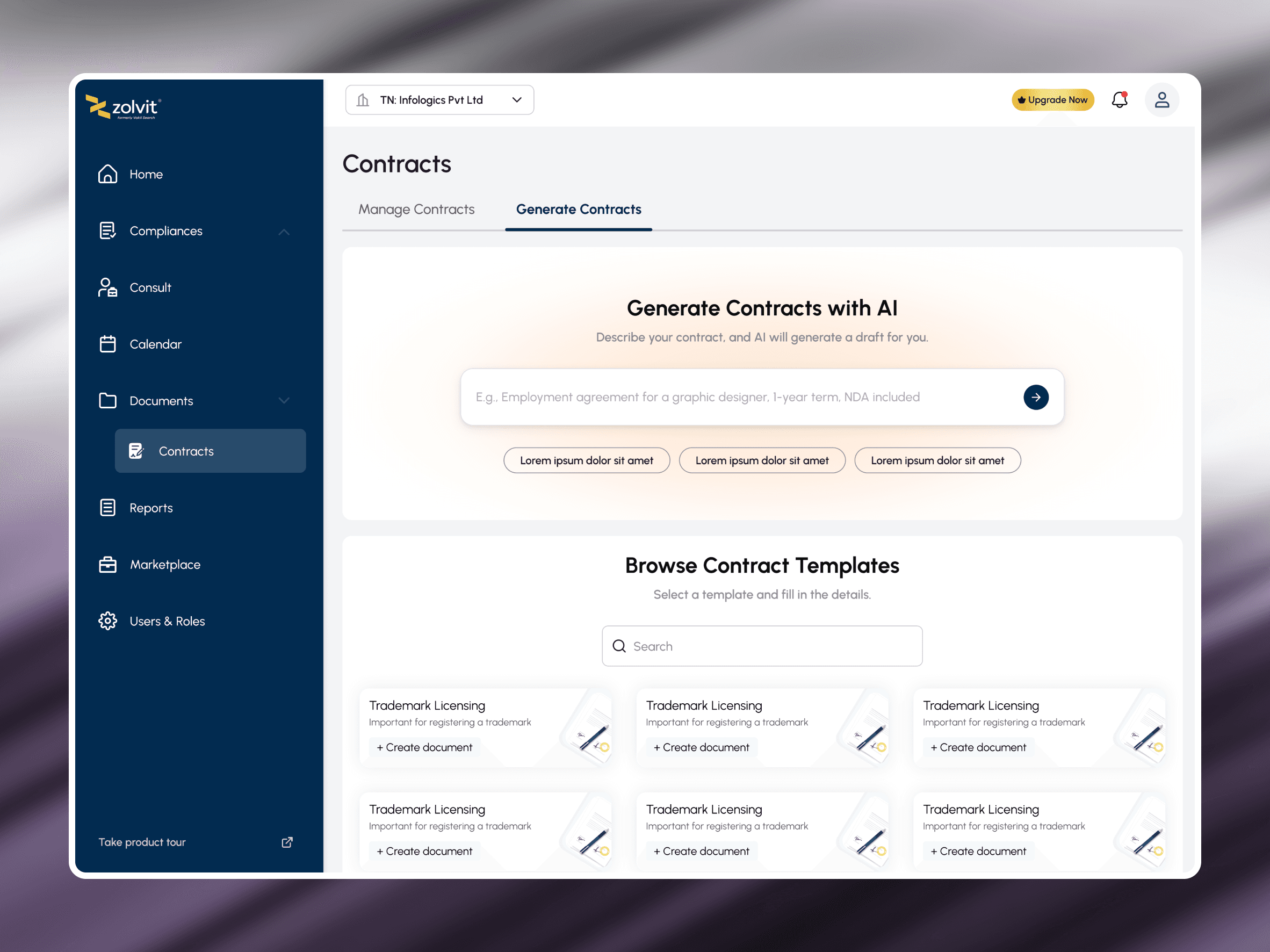
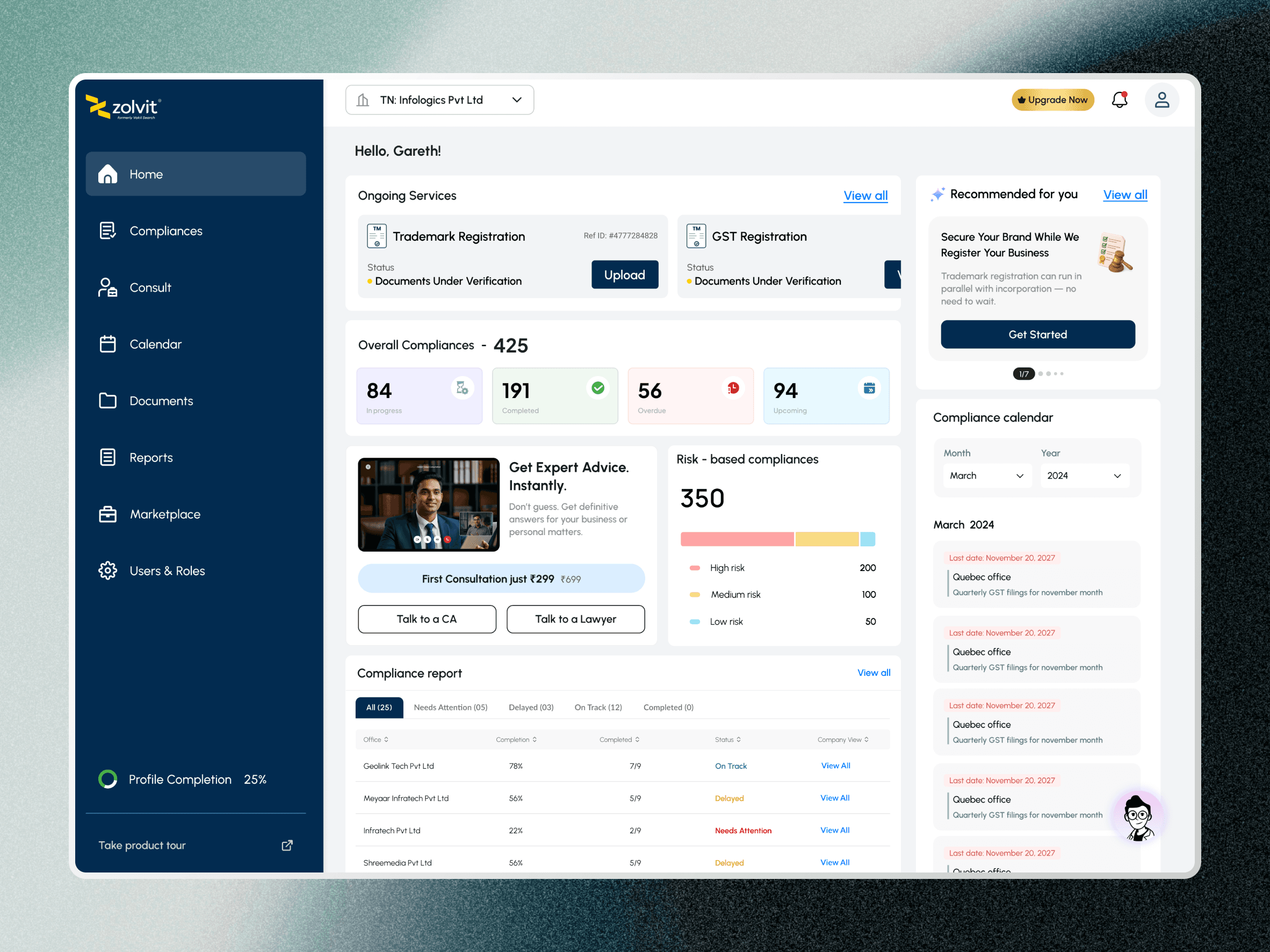
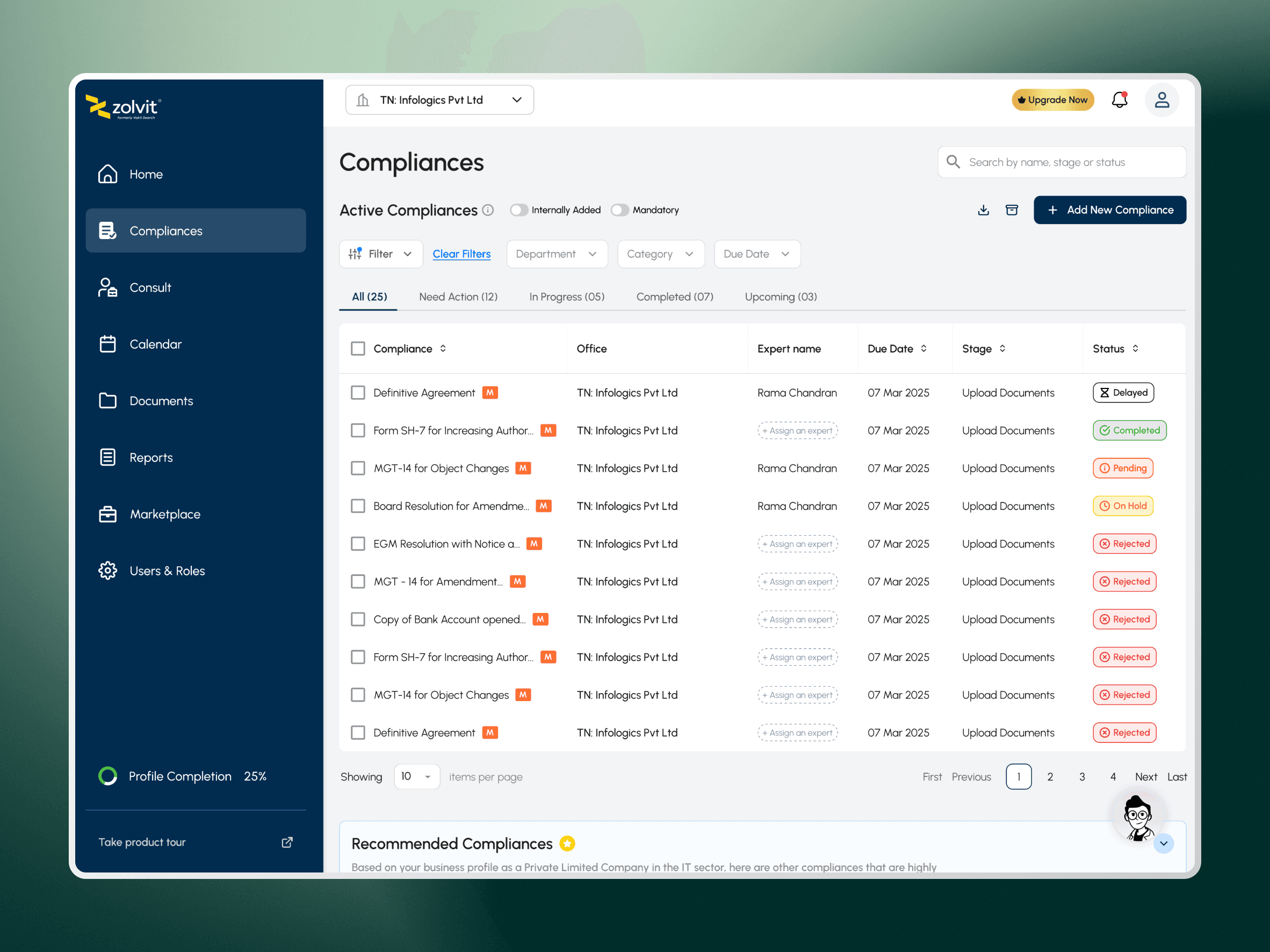
Zolvit 360 is a compliance management platform designed to help MSMEs track and complete their regulatory tasks effortlessly.
Role:
Senior Product Designer
Senior Product Designer
Company:
Zolvit
Zolvit
Year:
2025
2025
Bringing clarity to how small businesses manage their compliances.
When I first joined Zolvit, the product already existed.
Zolvit 360 was positioned as a compliance management tool for MSMEs — helping small and medium businesses track their government and legal obligations.
The intent was right. The execution wasn’t.
The product was cluttered, the onboarding was confusing, and most users didn’t really know what to do once they logged in. Compliance, for them, felt like a maze — too many steps, too much jargon, too little guidance.
So my role wasn’t to build something new — it was to bring order to something that already existed.
Bringing clarity to how small businesses manage their compliances.
When I first joined Zolvit, the product already existed.
Zolvit 360 was positioned as a compliance management tool for MSMEs — helping small and medium businesses track their government and legal obligations.
The intent was right. The execution wasn’t.
The product was cluttered, the onboarding was confusing, and most users didn’t really know what to do once they logged in. Compliance, for them, felt like a maze — too many steps, too much jargon, too little guidance.
So my role wasn’t to build something new — it was to bring order to something that already existed.
The Wake-Up Moment
It started with a simple realization:
“MSMEs don’t wake up thinking about compliance — they wake up thinking about survival.”
Most of our users weren’t compliance experts. They just wanted to make sure they didn’t miss a filing or deadline that could hurt their business.
But the product was designed like it assumed they already knew everything. The setup flow was long, technical, and overwhelming.
That’s when we decided to redesign Zolvit 360 around a single principle —
Help users get from confusion to clarity in the shortest possible path.
The Wake-Up Moment
It started with a simple realization:
“MSMEs don’t wake up thinking about compliance — they wake up thinking about survival.”
Most of our users weren’t compliance experts. They just wanted to make sure they didn’t miss a filing or deadline that could hurt their business.
But the product was designed like it assumed they already knew everything. The setup flow was long, technical, and overwhelming.
That’s when we decided to redesign Zolvit 360 around a single principle —
Help users get from confusion to clarity in the shortest possible path.
What Needed Fixing (and Why It Mattered)
The early version of Zolvit 360 made users go through multiple pages of data entry before they could see anything useful.
Drop-offs were high. Even those who completed onboarding rarely came back.
Instead of starting from scratch, I analyzed existing user behavior, support tickets, and feedback from the sales and CX teams to identify what was going wrong.
Three major insights stood out:
Users didn’t understand what “compliance readiness” meant.
The onboarding was long and abstract — users wanted to see instant value.
The dashboard didn’t tell them what to do next.
This was less a UX issue and more a confidence issue. Users needed reassurance that Zolvit was doing the heavy lifting — not them.
What Needed Fixing (and Why It Mattered)
The early version of Zolvit 360 made users go through multiple pages of data entry before they could see anything useful.
Drop-offs were high. Even those who completed onboarding rarely came back.
Instead of starting from scratch, I analyzed existing user behavior, support tickets, and feedback from the sales and CX teams to identify what was going wrong.
Three major insights stood out:
Users didn’t understand what “compliance readiness” meant.
The onboarding was long and abstract — users wanted to see instant value.
The dashboard didn’t tell them what to do next.
This was less a UX issue and more a confidence issue. Users needed reassurance that Zolvit was doing the heavy lifting — not them.
Redesigning the Flow — From Overload to Guidance
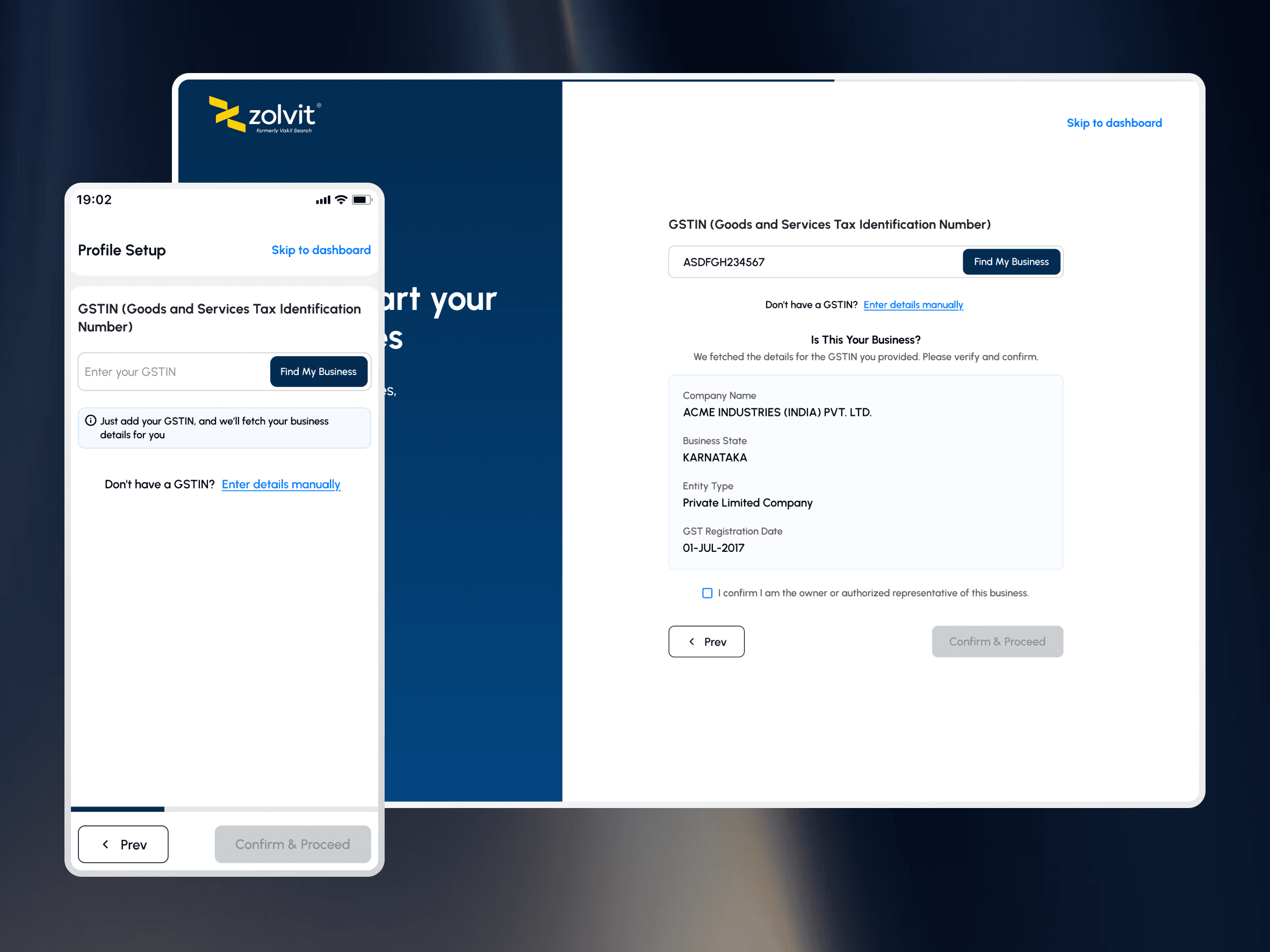
So we restructured the product experience around three clear stages:
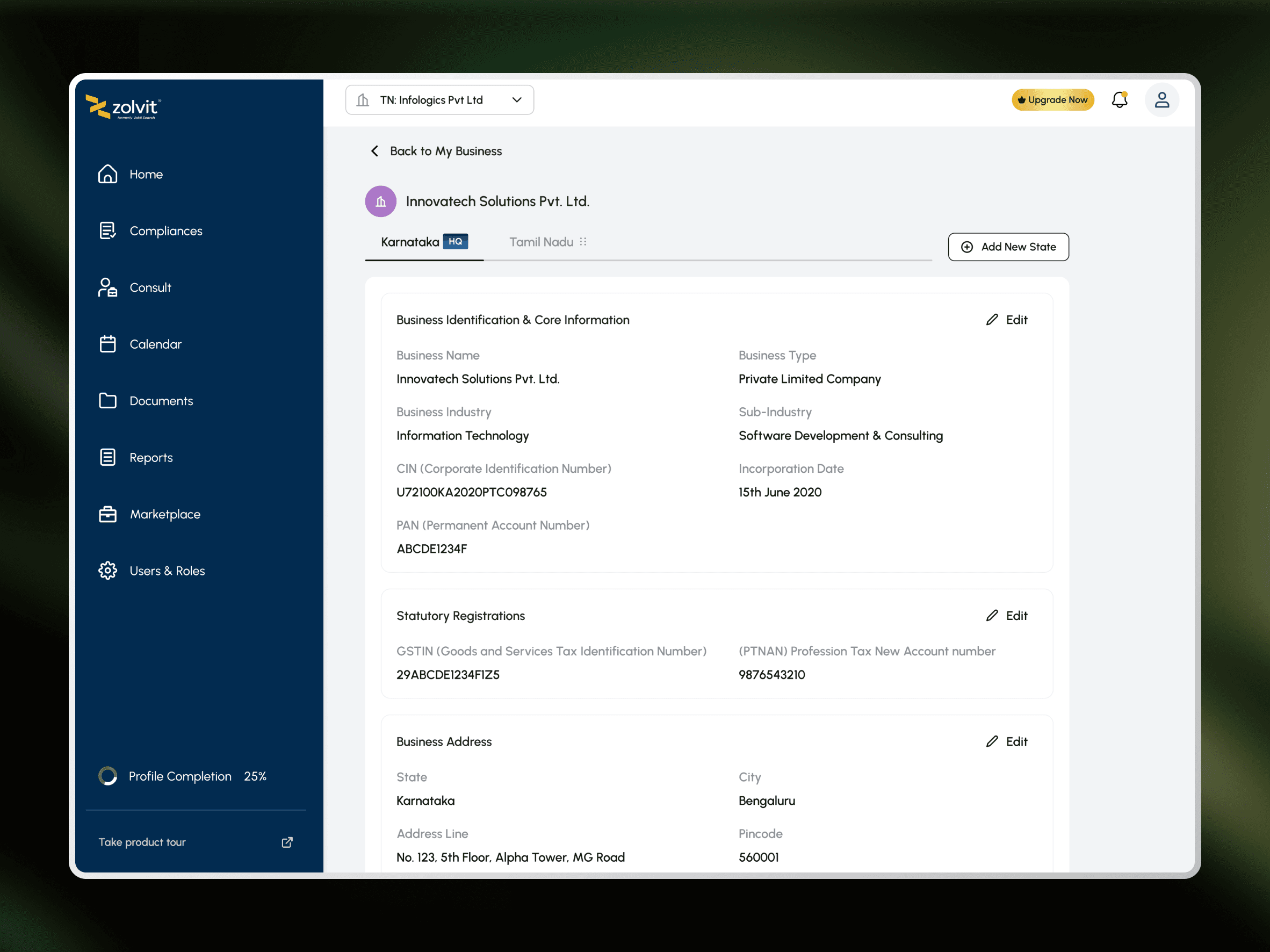
Collecting Business Details
Fetching Mandatory Compliances
Calculating Compliance Score
Each stage was designed to feel guided — almost conversational.
Users could see where they were in the process, what was happening behind the scenes, and what was coming next.
Instead of throwing everything at them upfront, the product now revealed complexity progressively.
And once users reached their Compliance Score, they didn’t just see a number — they saw actionable next steps.
That small change — turning information into guidance — was a game-changer.
So we restructured the product experience around three clear stages:
Collecting Business Details
Fetching Mandatory Compliances
Calculating Compliance Score
Each stage was designed to feel guided — almost conversational.
Users could see where they were in the process, what was happening behind the scenes, and what was coming next.
Instead of throwing everything at them upfront, the product now revealed complexity progressively.
And once users reached their Compliance Score, they didn’t just see a number — they saw actionable next steps.
That small change — turning information into guidance — was a game-changer.
Redesigning the Flow — From Overload to Guidance
So we restructured the product experience around three clear stages:
Collecting Business Details
Fetching Mandatory Compliances
Calculating Compliance Score
Each stage was designed to feel guided — almost conversational.
Users could see where they were in the process, what was happening behind the scenes, and what was coming next.
Instead of throwing everything at them upfront, the product now revealed complexity progressively.
And once users reached their Compliance Score, they didn’t just see a number — they saw actionable next steps.
That small change — turning information into guidance — was a game-changer.
The Design Decisions That Mattered
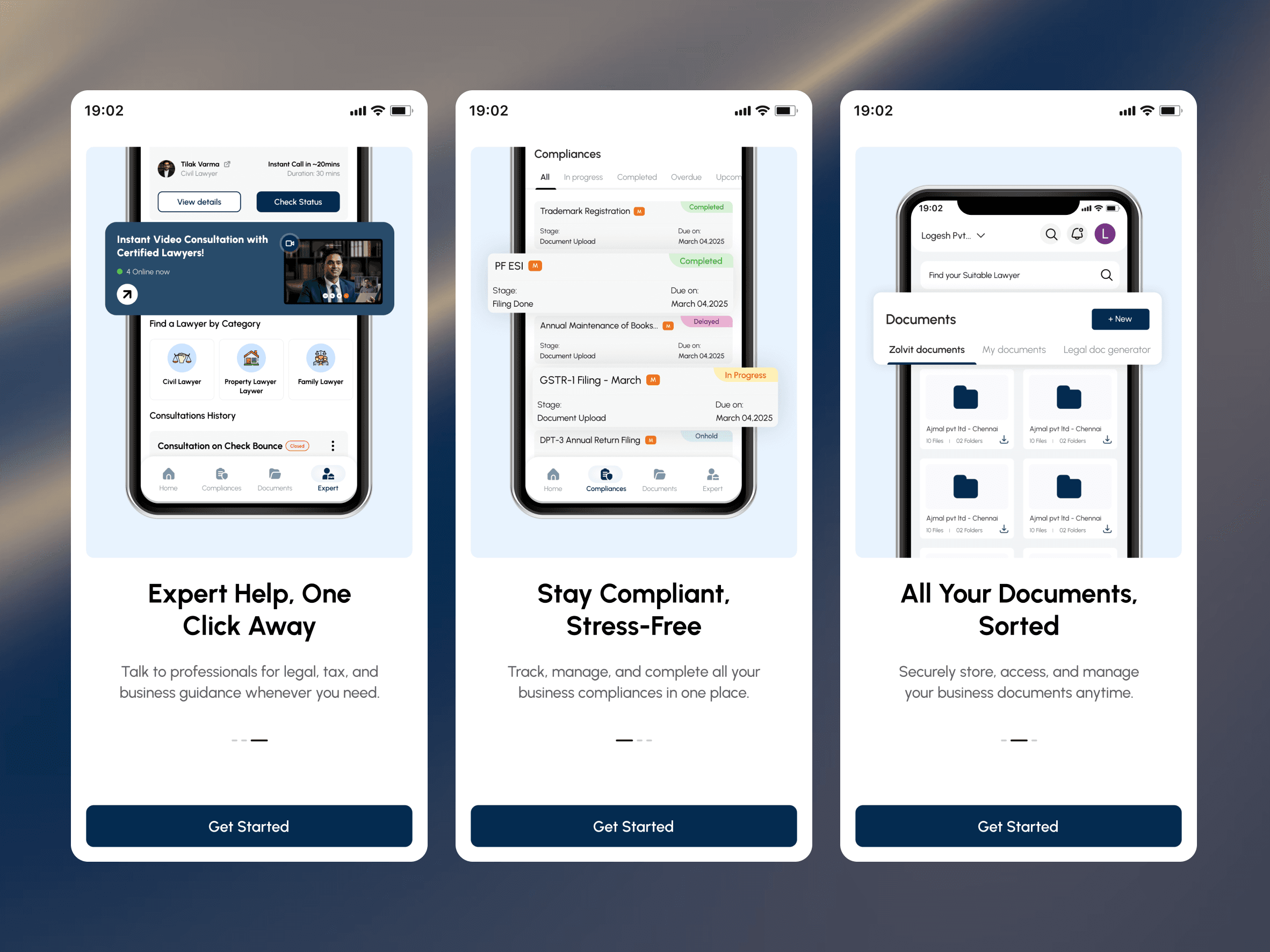
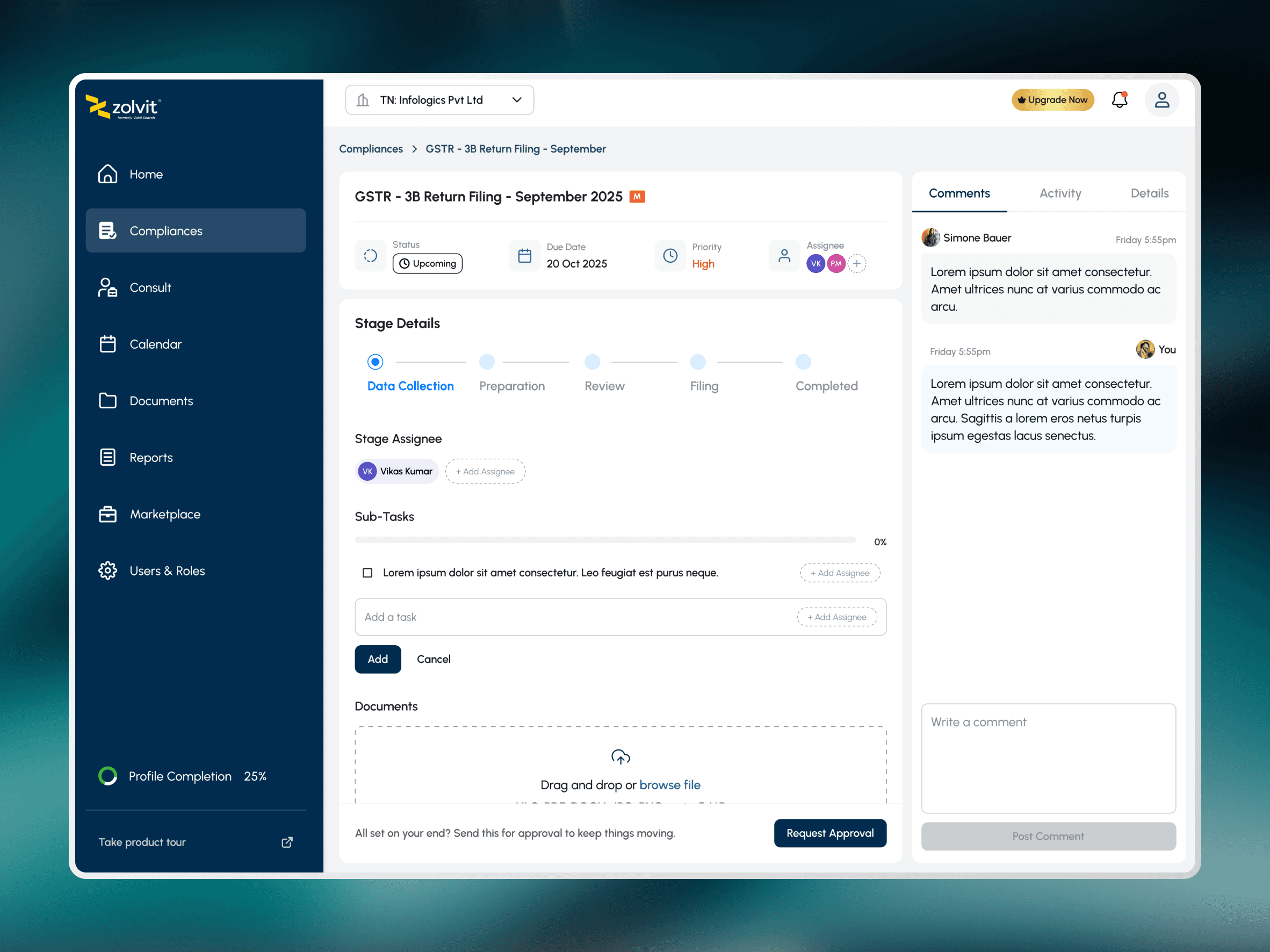
The improvements weren’t flashy; they were surgical.
Progressive disclosure: We reduced the cognitive load by showing only what’s needed at each step.
Compliance Score system: A visual feedback loop that tells MSMEs how “ready” they are — instantly quantifying progress.
Visual hierarchy & tone: Clean, friendly, and approachable — replacing legal heaviness with calm confidence.
Fallback handling: Even if users dropped off mid-onboarding, the platform remembered progress and nudged them to continue later.
Every design choice had one job — make compliance feel less like paperwork, and more like progress.
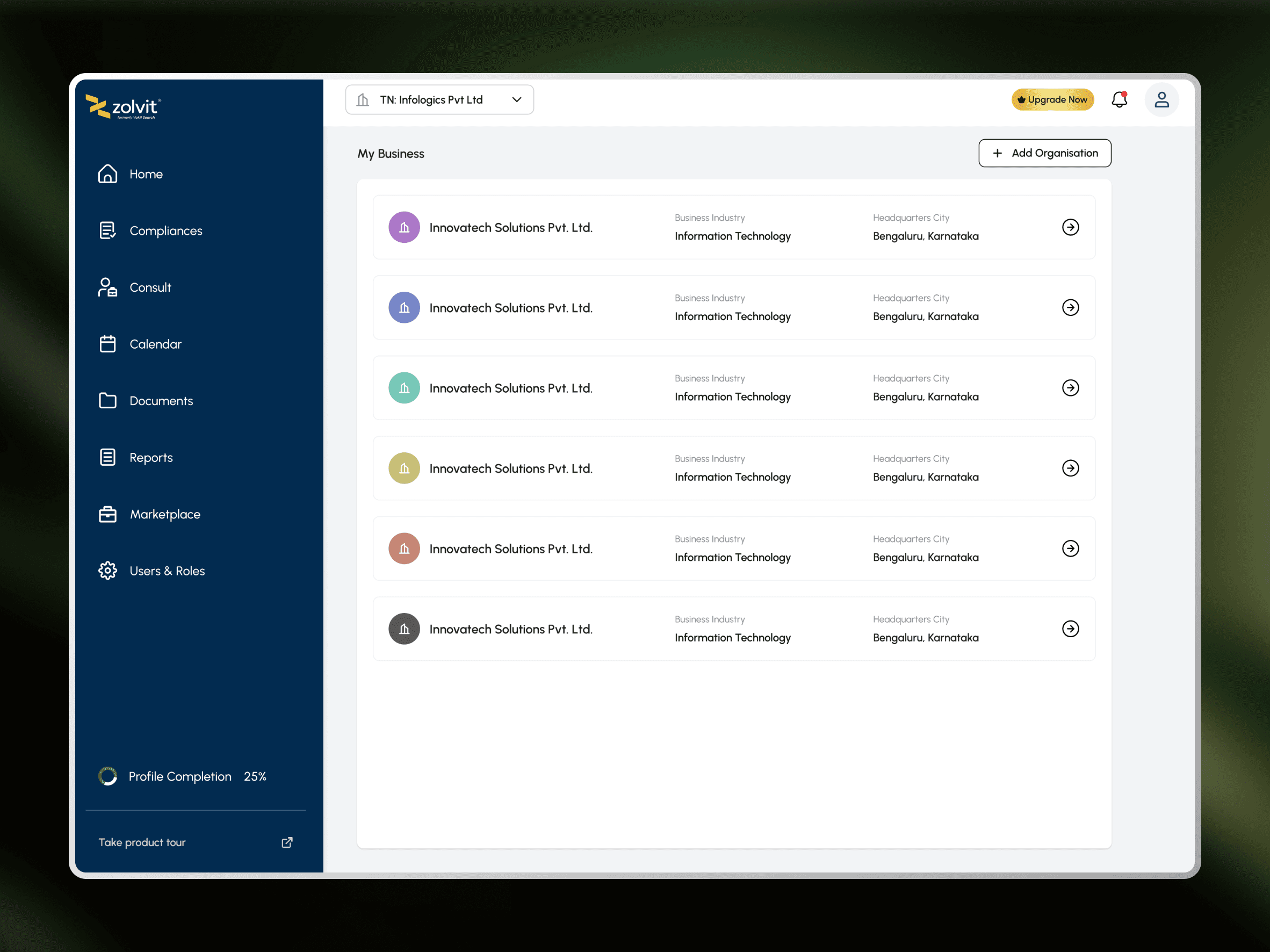
The Design Decisions That Mattered
The improvements weren’t flashy; they were surgical.
Progressive disclosure: We reduced the cognitive load by showing only what’s needed at each step.
Compliance Score system: A visual feedback loop that tells MSMEs how “ready” they are — instantly quantifying progress.
Visual hierarchy & tone: Clean, friendly, and approachable — replacing legal heaviness with calm confidence.
Fallback handling: Even if users dropped off mid-onboarding, the platform remembered progress and nudged them to continue later.
Every design choice had one job — make compliance feel less like paperwork, and more like progress.
Collaboration That Made It Work
This wasn’t a solo UX sprint.
It was a team realignment moment — working closely with the PM, engineers, CX team, and compliance experts to balance business feasibility with simplicity.
The challenge wasn’t just designing better screens — it was convincing everyone that “less” could actually do “more.”
Through multiple internal reviews, we aligned on a new definition of product success:
fewer drop-offs,
more activations,
and a product that felt human, even in a compliance-driven space.
Collaboration That Made It Work
This wasn’t a solo UX sprint.
It was a team realignment moment — working closely with the PM, engineers, CX team, and compliance experts to balance business feasibility with simplicity.
The challenge wasn’t just designing better screens — it was convincing everyone that “less” could actually do “more.”
Through multiple internal reviews, we aligned on a new definition of product success:
fewer drop-offs,
more activations,
and a product that felt human, even in a compliance-driven space.